The rings
Billions of pieces of ice.
One thin, bright plane.
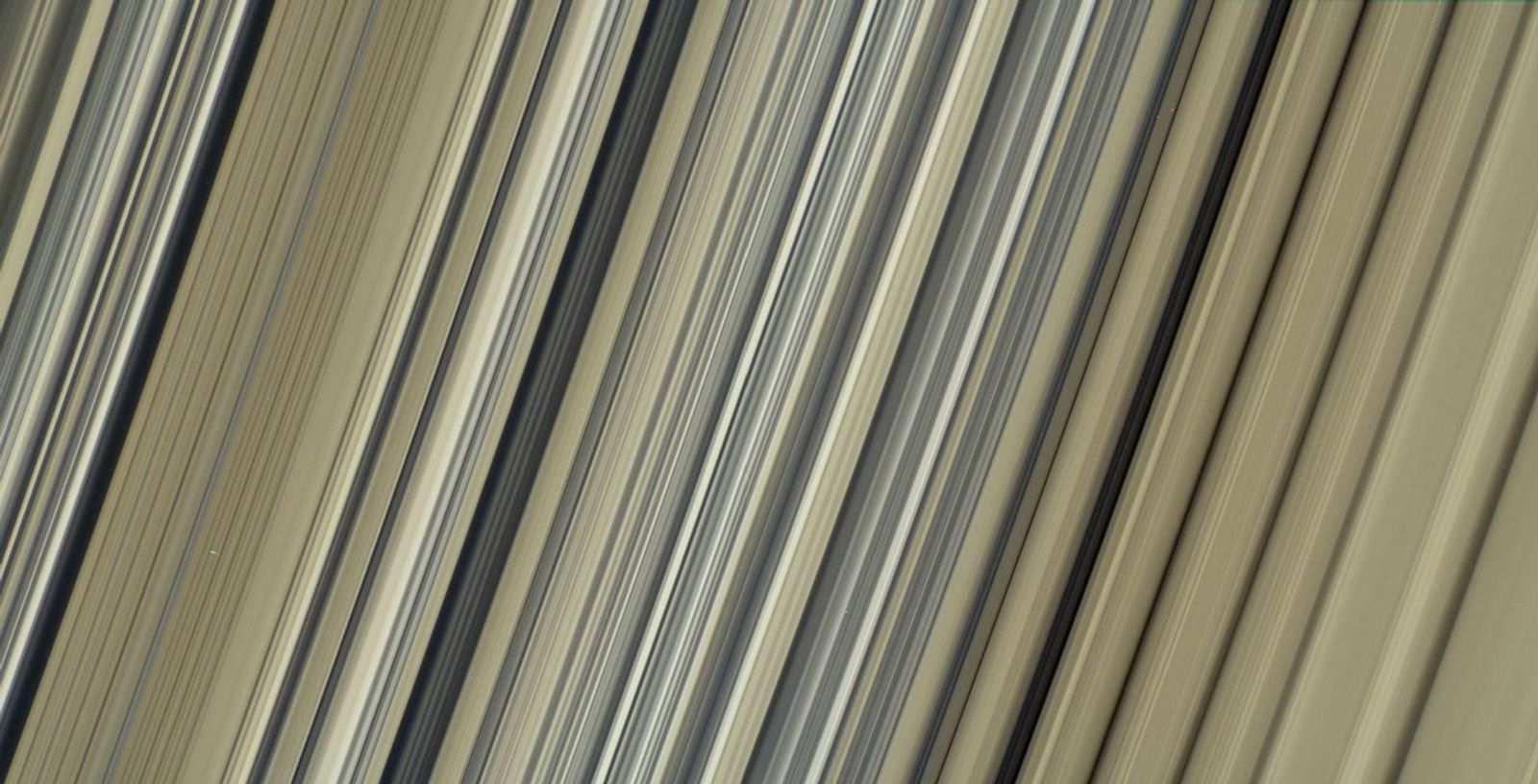
Saturn’s main rings are almost entirely water ice, in pieces from smaller than a grain of sand to the size of a mountain — and generally only about 10 meters thick. See them to scale, then read six real Cassini radio observations yourself.
Source: NASA Science: Cassini science: Rings (opens in a new tab)
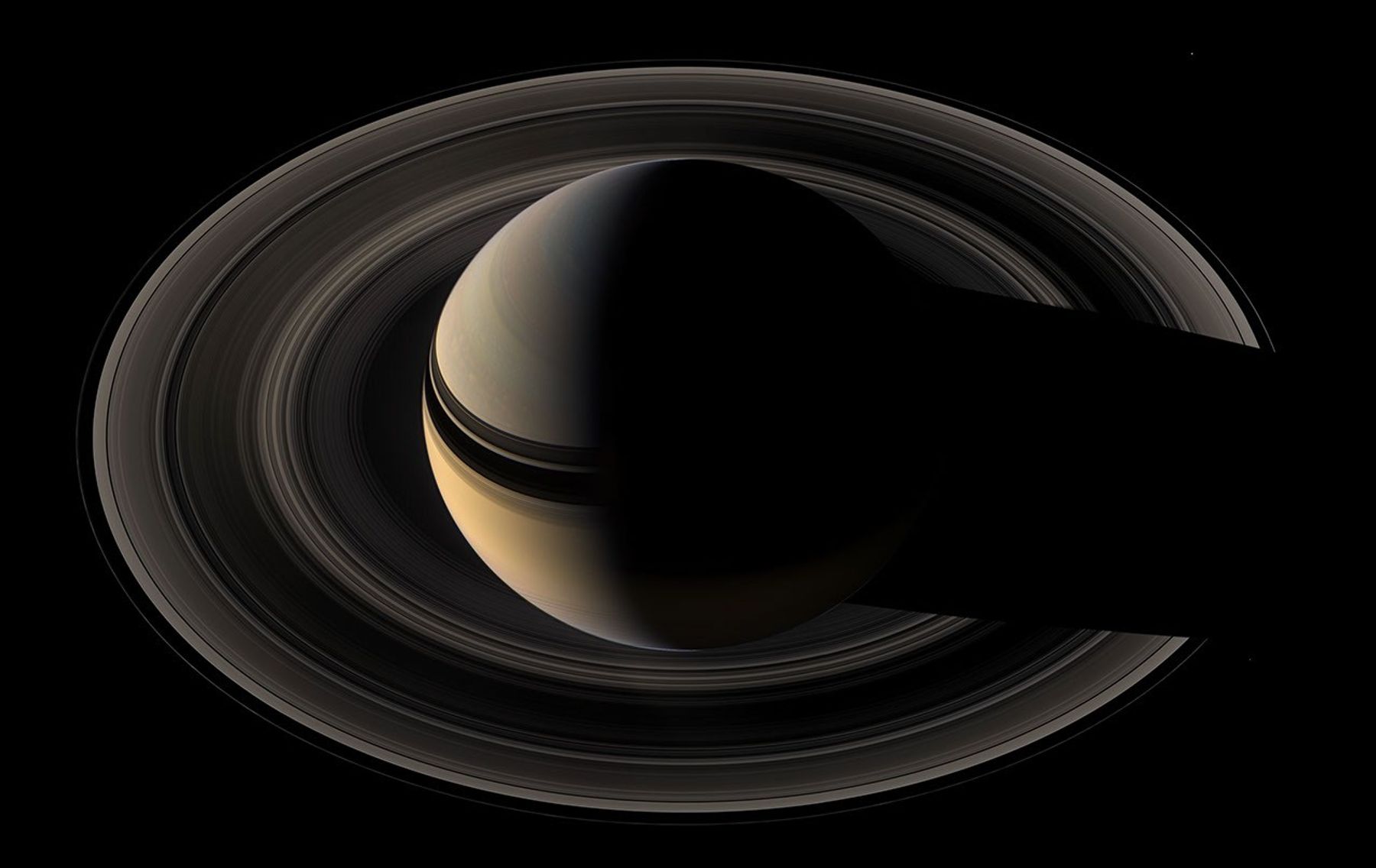
01 / To scale
From the D ring
to the F ring.
Ring radii are measured from Saturn’s center. Brighter bands block more light; dark notches are gaps. Select any ring or gap to open that region in the data explorer.

| Feature | Inner radius (km) | Outer radius (km) | Typical optical depth | Notes | Explore |
|---|---|---|---|---|---|
| D ring | 66,900 | 74,491 | 10⁻⁵ to 10⁻³ | Tenuous; narrow ringlets at 67,580 and 71,710 km. | Open in Rev 007 the D ring |
| C ring | 74,491 | 91,975 | 0.05 to 0.35 | Isolated plateaus within a fainter ring. | Open in Rev 007 the C ring |
| Colombo Gap | 77,748 | 77,926 | ~0 | The Titan Ringlet occupies its outer third. | Open in Rev 007 the Colombo Gap |
| Maxwell Gap | 87,343 | 87,610 | ~0 | The widest gap in the C ring. | Open in Rev 007 the Maxwell Gap |
| B ring | 91,975 | 117,570 | 0.4 to 5 | The most opaque ring, with fine structure on all scales. | Open in Rev 007 the B ring |
| Cassini Division | 117,500 | 122,050 | 0 to 0.2 | A broad, low-optical-depth region between the B and A rings. | Open in Rev 007 the Cassini Division |
| Huygens Gap | 117,500 | 117,930 | ~0 | Associated with the moon Mimas. | Open in Rev 007 the Huygens Gap |
| A ring | 122,050 | 136,770 | 0.4 to 1 | Density and bending waves, especially near its outer edge. | Open in Rev 007 the A ring |
| Encke Gap | 133,423 | 133,745 | ~0 | Kept open by the embedded moon Pan; faint ringlets inside. | Open in Rev 007 the Encke Gap |
| Keeler Gap | 136,487 | 136,522 | ~0 | Kept open by the embedded moon Daphnis. | Open in Rev 007 the Keeler Gap |
| F ring | 139,826 | 140,612 | 0.01 to 0.2 | Narrow, eccentric and inclined; denser core near 140,224 km.In the six profiles on this site, the F ring barely rises above the background. | Open in Rev 007 the F ring |
| Janus/Epimetheus ring | 149,000 | 154,000 | 10⁻⁷ | Very faint, in the region of the two moons’ orbits. | Beyond these profiles |
| G ring | 166,000 | 173,200 | 10⁻⁶ | Faint dust ring associated with the moonlet Aegaeon. | Beyond these profiles |
| E ring | 180,000 | 480,000 | 5 × 10⁻⁶ | Broad dust ring from just inside Mimas’s orbit to beyond Dione’s, densest near Enceladus. | Beyond these profiles |
| Phoebe ring | 7,720,000 | 12,500,000 | ~2 × 10⁻⁸ | Huge, faint ring associated with the distant moon Phoebe; extent as reported at its discovery in 2009. | Beyond these profiles |
Source: NASA PDS Ring-Moon Systems Node: Vital Statistics for Saturn’s Rings (opens in a new tab)
02 / Moons & gaps
Moons carve the gaps.
Some hide inside the rings.
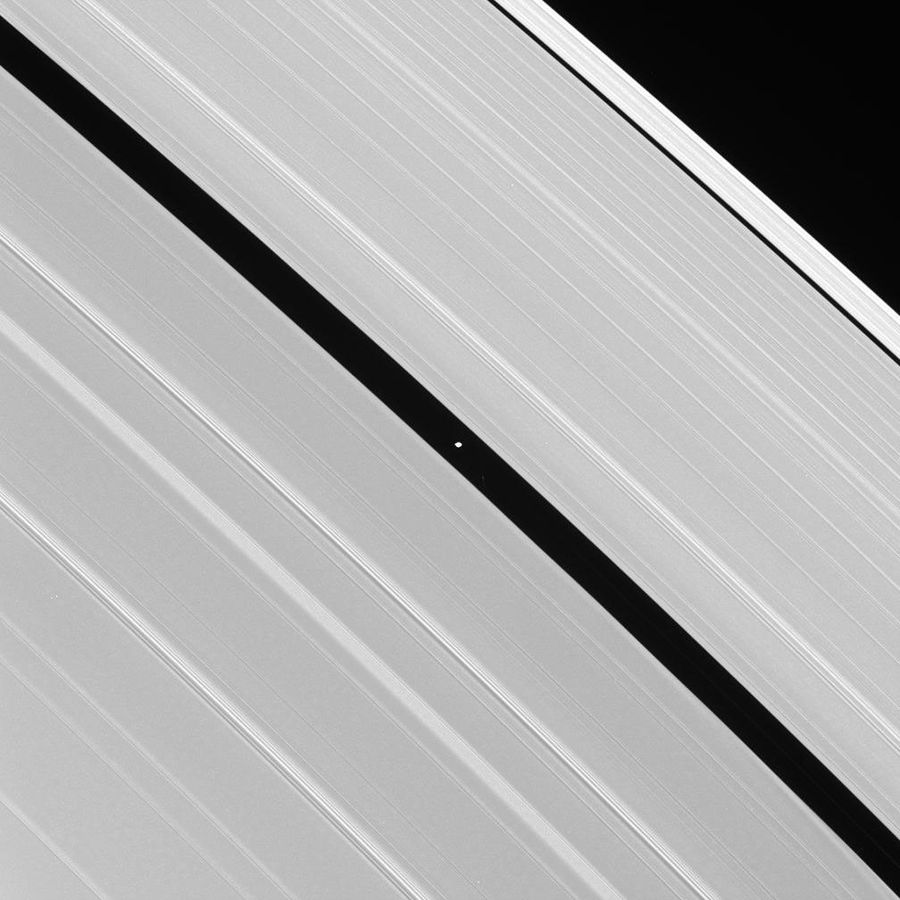
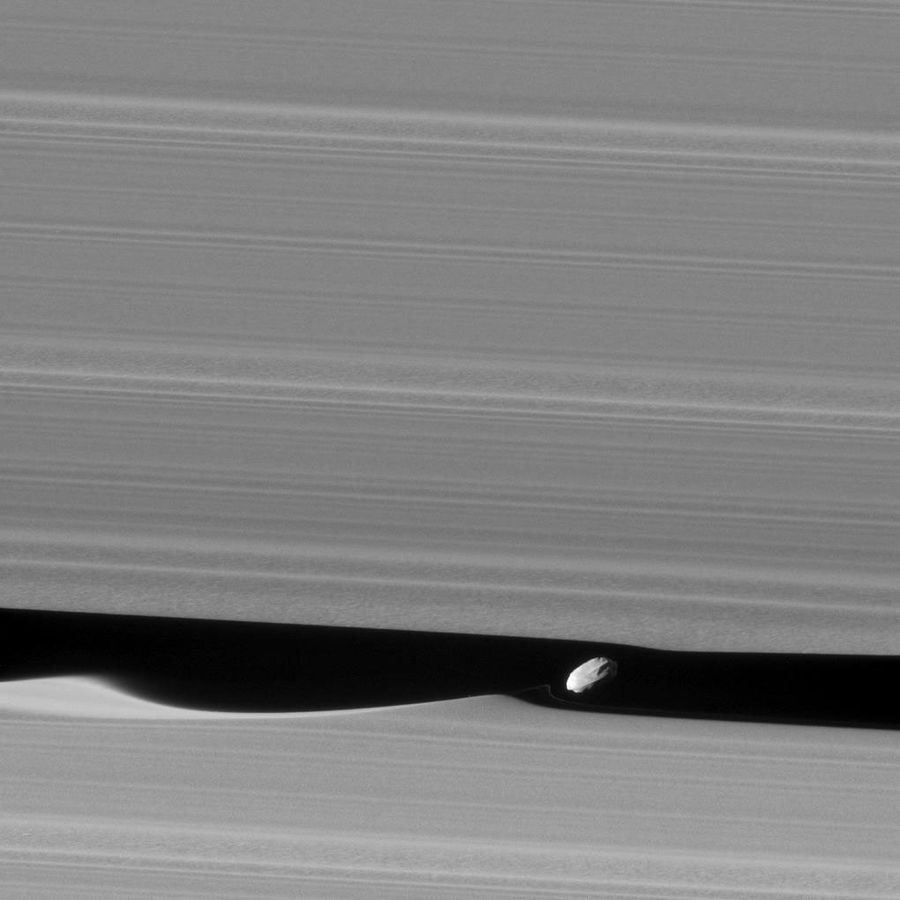
Pan orbits inside the Encke Gap and Daphnis inside the Keeler Gap; each keeps its gap open. The PDS ring table associates the Huygens Gap, at the inner edge of the Cassini Division, with Mimas.
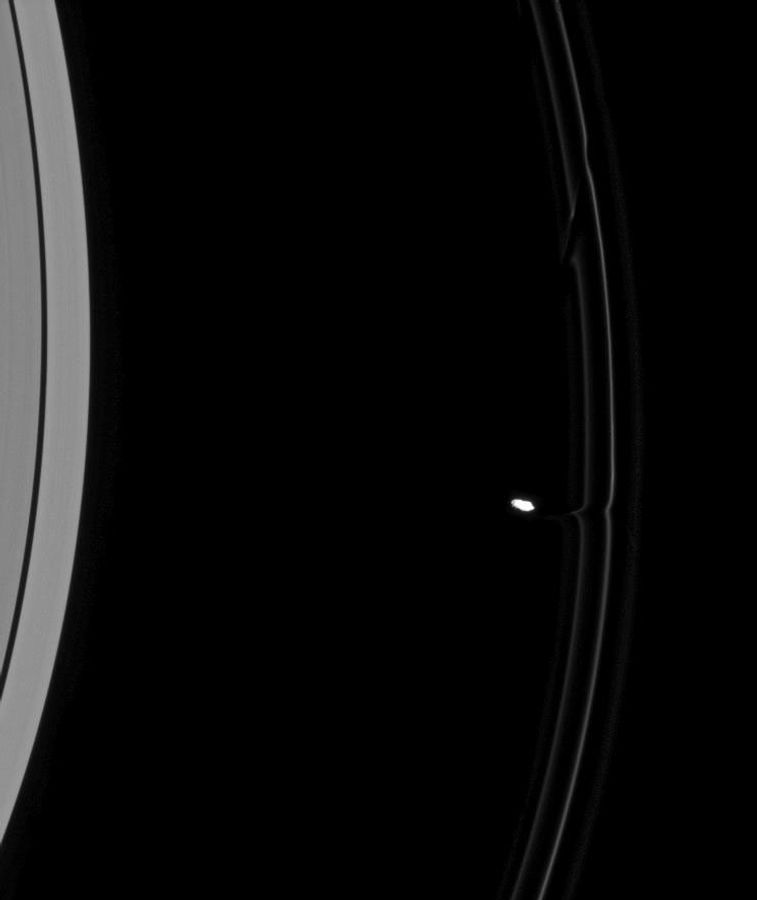
The narrow F ring is herded by the shepherd moons Prometheus and Pandora. Far beyond the main rings, ice from the jets of Enceladus supplies the faint E ring.
Cassini watched some moons take particles from the rings and others add to them.
Sources: NASA PDS Ring-Moon Systems Node: Vital Statistics for Saturn’s Rings (opens in a new tab)NASA History: 40 Years Ago: Voyager 2 Explores Saturn (opens in a new tab)NASA Science: Enceladus: Enceladus (opens in a new tab), Cassini rings science: Cassini science: Rings (opens in a new tab)
Meet the moonsNot everything is a moon
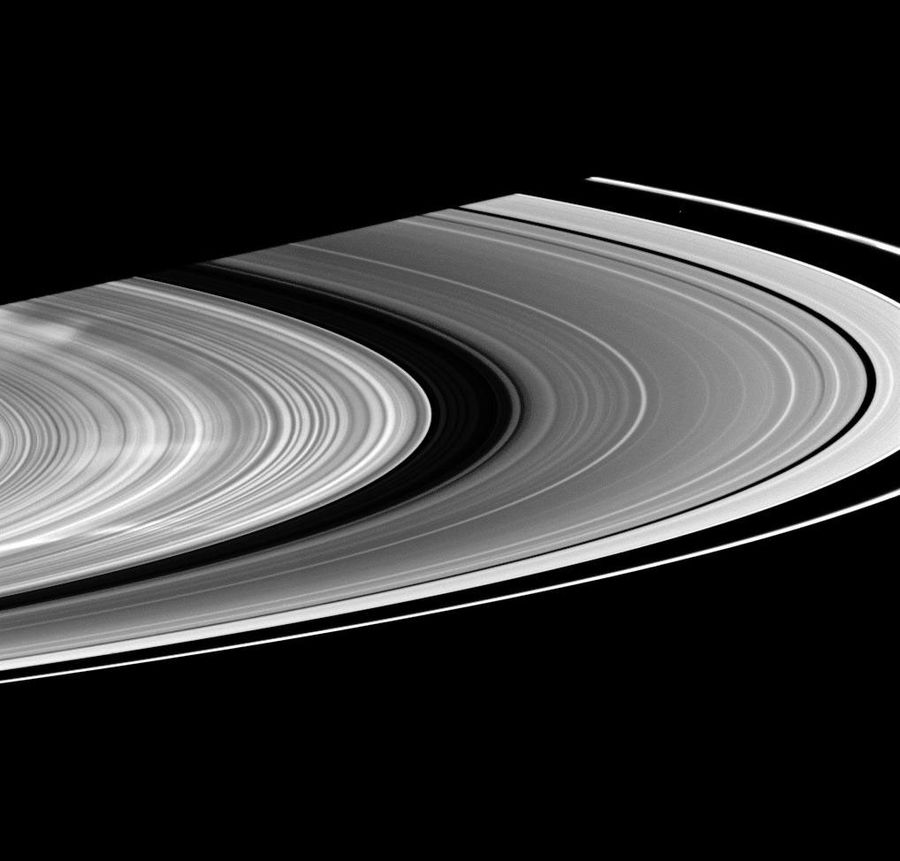
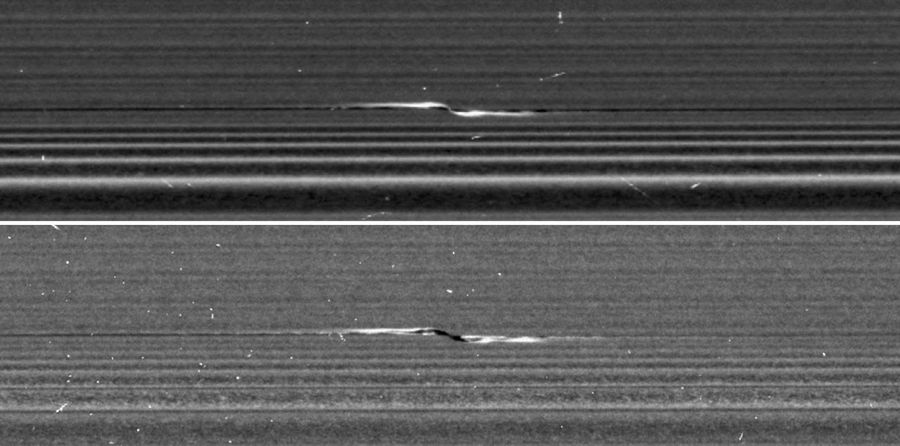
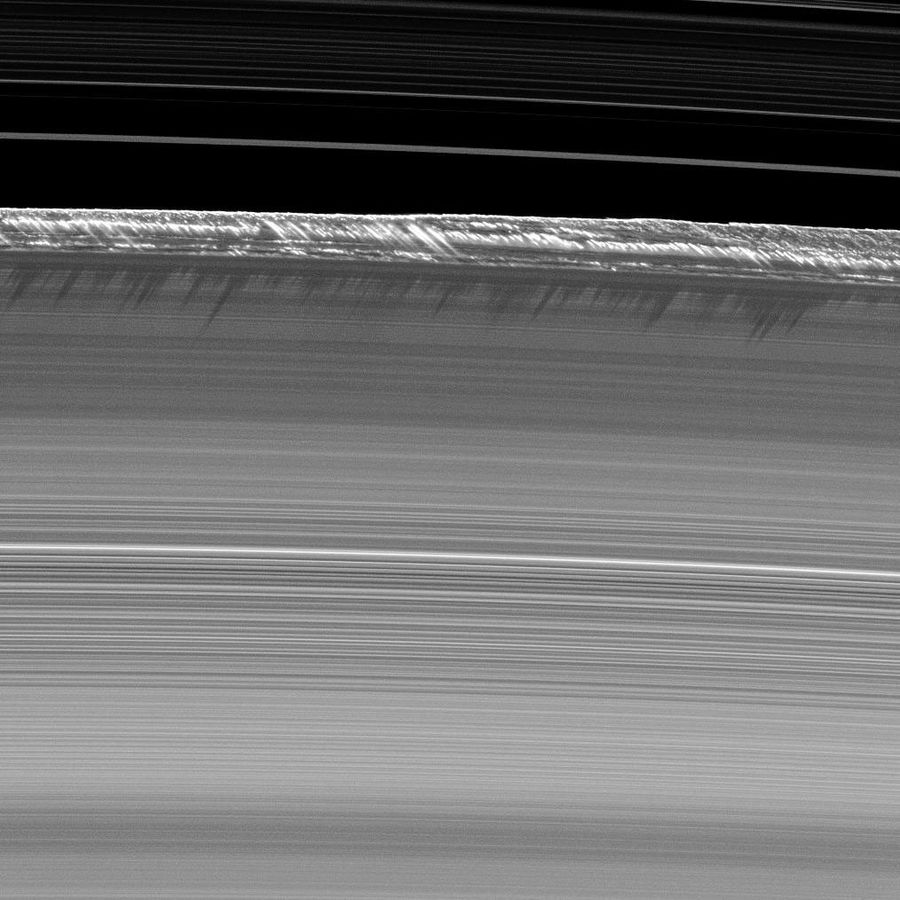
Spokes and propellers.
Spokes are fleeting streaks across the rings, thought to be made of tiny ice particles lifted above the ring surface. They can be longer than 16,000 km — wider than Earth — and can form in about the time it takes to eat breakfast.
Propellers are disturbances made by moonlets about 1 km across, which launch the surrounding ring particles tens to hundreds of meters above and below the ring plane.
Source: NASA Science: Cassini science: Rings (opens in a new tab)
03 / Reading a signal
A radio signal
through the rings.
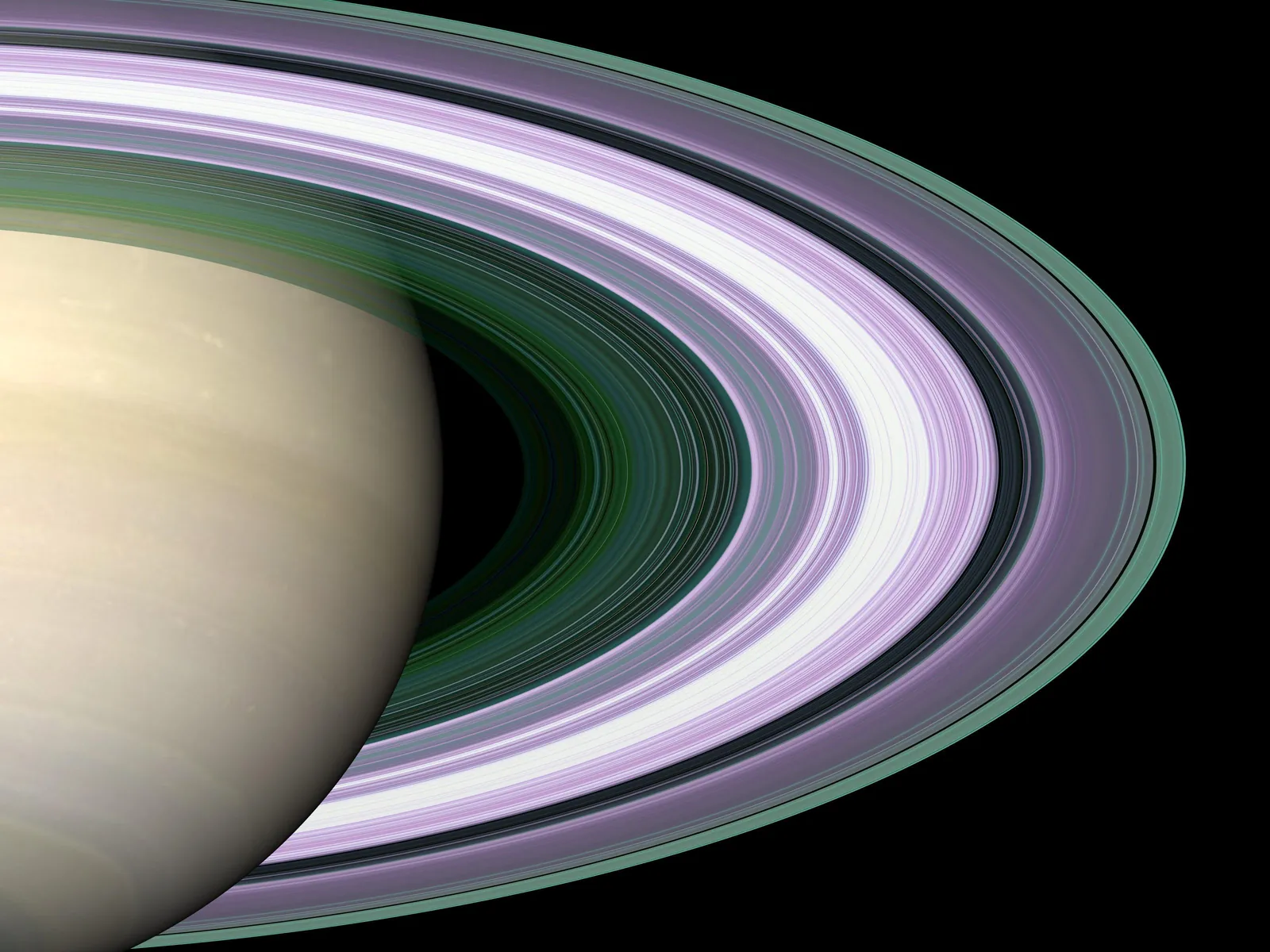
Cassini repeatedly sent radio signals through the rings toward Earth. Where the rings held more material, less signal came through. Six of those recordings, made between 2005 and 2010, are on this site, from the NASA Planetary Data System.
- Radio occultation
- Cassini sent a radio signal toward Earth through the rings. Ring material along the path weakened the signal and shifted its phase; antennas on Earth recorded the result.
- Ring radius
- The distance, in kilometers, from Saturn’s center to the point where the signal crossed the ring plane.
- Normal optical depth
- How strongly the ring weakened the signal, converted to a path straight through the ring. Zero means the signal passed freely; larger numbers mean more was blocked. It has no unit and is not a direct measure of mass.
- Normalized signal power
- The received power divided by the power expected with no rings in the way, so 1 means unobstructed.
- Phase shift
- The change in the timing of the radio wave, in degrees. This site shows the stored values without unwrapping them.
- Diffraction-limited profile
- Radio waves spread and interfere, which blurs the finest structure. These archived profiles keep that blur; recovering sharper detail takes further processing that this site does not do.
- Ingress and egress
- Labels for the two directions in which the signal path can cross the rings during an occultation. Each profile records one.
- Rev
- Cassini’s label for each orbit (revolution) of Saturn. A redesign of the early tour replaced Revs 1 and 2 with Revs A, B and C, so Rev 133 is not exactly the 133rd orbit.
04 / Try it yourself
Five guided observations
in real Cassini data.
Each link opens the data explorer at a chosen window. The numbers below were measured from the same exact samples you will see. The six profiles were recorded between May 3, 2005 and June 19, 2010.
Guided activity · about 10 minutes
Is the Encke Gap the same width in every observation?
Measure the gap in two observations with the same rule, change one setting, and save a record someone else can reproduce.
Where the C ring meets the B ring
What happens to the signal as it leaves the C ring and enters the B ring?
- Where to look
- Rev 064 (April 11, 2008), 89,000–95,000 km.
- What to do
- Read the optical depth from left to right and find the radius where it jumps.
- What the data show
- In Rev 064 the median optical depth is about 0.18 across this part of the C ring and about 1.2 in the inner B ring. It first rises above 1 near 92,002 km, close to the 91,975 km boundary in the PDS ring table.
- Keep in mind
- A higher optical depth means the ring blocked more of the signal. On its own it is not a measure of mass.
A gap that is not empty
The Maxwell Gap is the widest gap in the C ring. Is there anything inside it?
- Where to look
- Rev 044 (May 10, 2007), 87,200–87,750 km.
- What to do
- Find the low, flat stretch of the gap, then look for a narrow spike inside it.
- What the data show
- Most of the gap sits near zero optical depth, but a narrow ringlet inside it reaches about 2.8 near 87,530 km in Rev 044. Open the same window in another observation: the spike sits at a slightly different radius each time, between about 87,500 and 87,556 km in the five profiles that cover this gap.
- Keep in mind
- Comparing radii between observations tells you the ringlet’s position changes; the plot alone cannot tell you why.
Find the Cassini Division
Giovanni Cassini saw a dark band between two rings in 1675. What does it look like in a radio signal?
- Where to look
- Rev 007 (May 3, 2005), 115,500–123,500 km.
- What to do
- Compare the left edge (outer B ring), the middle, and the right edge (inner A ring).
- What the data show
- In Rev 007 the median optical depth is about 2.2 at the outer edge of the B ring, drops to about 0.16 across the Cassini Division, and rises to about 1.3 in the inner A ring.
- Keep in mind
- The division is not empty: its optical depth is low but not zero, and it contains narrow features of its own.
Measure the Encke Gap
The tiny moon Pan keeps a gap open in the outer A ring. How wide is it?
- Where to look
- Rev 123 (December 26, 2009), 133,250–133,950 km.
- What to do
- Choose point A at the gap’s inner edge and point B at its outer edge, then read the radius difference.
- What the data show
- In Rev 123 the optical depth stays below 0.05 from about 133,428 km to 133,744 km — roughly 316 km — while the A ring on either side sits near 0.4. The PDS ring table lists the gap at 133,423–133,745 km.
- Keep in mind
- Where you place an “edge” depends on the threshold you choose; write yours down with your measurement.
Same ring, different years
Five observations cross the same stretch of the B ring between 2005 and 2010. Do they agree?
- Where to look
- Rev 007 (May 3, 2005), 100,000–104,000 km; then Rev 133 (June 19, 2010).
- What to do
- Open the 2005 view, then the 2010 view, and compare the typical optical depth.
- What the data show
- The median optical depth in this window is about 2.8 in Rev 007 (2005), 1.8 in Rev 044 (2007), 1.3 in Rev 064 (2008), 0.61 in Rev 123 (2009) and 0.31 in Rev 133 (2010).
- Keep in mind
- This does not show the B ring thinning. Each signal crossed the rings at a different angle, the files correct optical depth for that angle, and a ring that blocks almost all of the signal can only be measured up to a limit. Before comparing observations, check how each was made.
Save what you notice in your notebook from the explorer. Your notes stay in this browser.
05 / An open question
How old
are the rings?
Cassini found the rings remarkably clean: more than 99% water ice. Dust falling in from space should slowly darken them, so studies in the 2010s and 2020s estimated that the rings are no more than a few hundred million years old — far younger than Saturn.
A 2024 study in Nature Geoscience argued that incoming micrometeoroids hit the rings so fast that they vaporize, and the vapor is swept away instead of darkening the rings. If so, the rings could have stayed clean for billions of years, possibly as long as the solar system has existed. Both ideas are still being tested.
Sources: Institut de physique du globe de Paris: A new perspective on the age of Saturn’s rings (opens in a new tab)Nature Geoscience: Hyodo, Genda & Madeira, Nature Geoscience (2024) (opens in a new tab)
Sources
Where these facts come from
Measurements in the guided observations come from the archived Cassini RSS profiles on this site and are checked automatically against those files. Ring radii and typical optical depths come from the PDS ring table.
- Vital Statistics for Saturn’s Rings (opens in a new tab)NASA PDS Ring-Moon Systems Node
- Cassini science: Rings (opens in a new tab)NASA Science
- 40 Years Ago: Voyager 2 Explores Saturn (opens in a new tab)NASA History
- Enceladus (opens in a new tab)NASA Science
- A new perspective on the age of Saturn’s rings (opens in a new tab)Institut de physique du globe de Paris · January 23, 2025
- Hyodo, Genda & Madeira, Nature Geoscience (2024) (opens in a new tab)Nature Geoscience
- Cassini RSS ring occultation archive (opens in a new tab)NASA PDS Ring-Moon Systems Node