The planet
A giant made of gas.
Less dense than water.
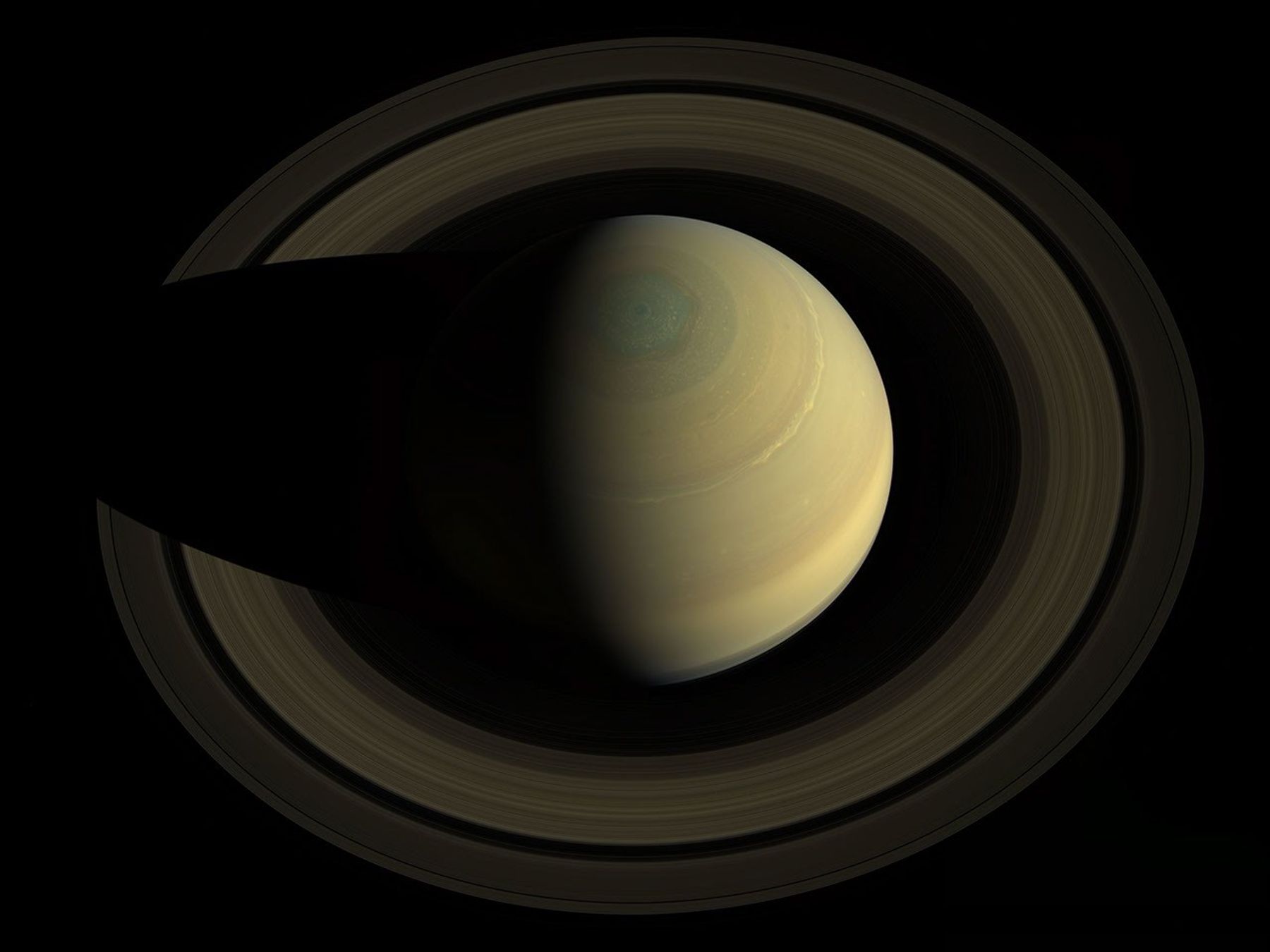
Saturn is about 9.4 times as wide as Earth and 95 times as massive. Here is what spacecraft and telescopes have measured — with a source for every number.
01 / At a glance
Saturn in
eight numbers.
Each value links to the source it was checked against.
- Average distance from the Sun
- 9.5 AUAbout 1.4 billion km. Sunlight takes about 80 minutes to arrive.
- One orbit of the Sun
- 29.4 yearsAbout 10,756 Earth days.
- One rotation
- 10 h 33 m10 hours, 33 minutes and 38 seconds, measured from waves in the rings (2019).
Source: NASA JPL: Scientists Finally Know What Time It Is on Saturn (opens in a new tab)
- Width at the equator
- 9.4 × EarthEquatorial radius 60,268 km; polar radius 54,364 km.
Source: NASA Space Science Data Coordinated Archive: Saturn Fact Sheet (opens in a new tab)
- Mass
- 95 × Earth568.32 × 10²⁴ kg.
Source: NASA Space Science Data Coordinated Archive: Saturn Fact Sheet (opens in a new tab)
- Average density
- 0.687 g/cm³Lower than water — the only planet in the solar system for which that is true.
Sources: NASA Space Science Data Coordinated Archive: Saturn Fact Sheet (opens in a new tab)NASA Science: Saturn: Facts (opens in a new tab)
- Axial tilt
- 26.73°Enough for seasons; each lasts about seven Earth years.
Source: NASA Space Science Data Coordinated Archive: Saturn Fact Sheet (opens in a new tab)
- Confirmed moons
- 293As of August 2026.
02 / Inside
No surface to stand on.
Only deeper, denser layers.
Saturn has no true surface. NASA describes a dense core of metals such as iron and nickel, surrounded by rocky material and enveloped by liquid metallic hydrogen inside a layer of liquid hydrogen. The core is similar to Jupiter’s, but considerably smaller.
By volume, its atmosphere is about 96% molecular hydrogen and 3% helium. Spread through its enormous volume, that mass gives Saturn an average density of 0.687 g/cm³ — the only planet in the solar system less dense than water.
Saturn is also visibly flattened: its polar radius, 54,364 km, is about 10% smaller than its equatorial radius of 60,268 km.
Sources: NASA Science: Saturn: Facts (opens in a new tab)NASA Space Science Data Coordinated Archive: Saturn Fact Sheet (opens in a new tab)
| Equatorial radius (1 bar) | 60,268 km |
|---|---|
| Polar radius | 54,364 km |
| Volumetric mean radius | 58,232 km |
| Mass | 568.32 × 10²⁴ kg |
| Mean density | 687 kg/m³ |
| Gravity (mean, 1 bar) | 11.19 m/s² |
| Escape velocity | 35.5 km/s |
| Semimajor axis of orbit | 1,432.041 × 10⁶ km |
| Sidereal orbit period | 10,755.699 days |
| Orbit eccentricity | 0.0520 |
| Obliquity to orbit | 26.73° |
| Sidereal rotation period | 10.656 hours |
| Temperature at 1 bar | 134 K (−139 °C) |
| Atmosphere by volume | H₂ 96.3% · He 3.25% |
03 / Weather
Winds more than four times
faster than Earth’s strongest.
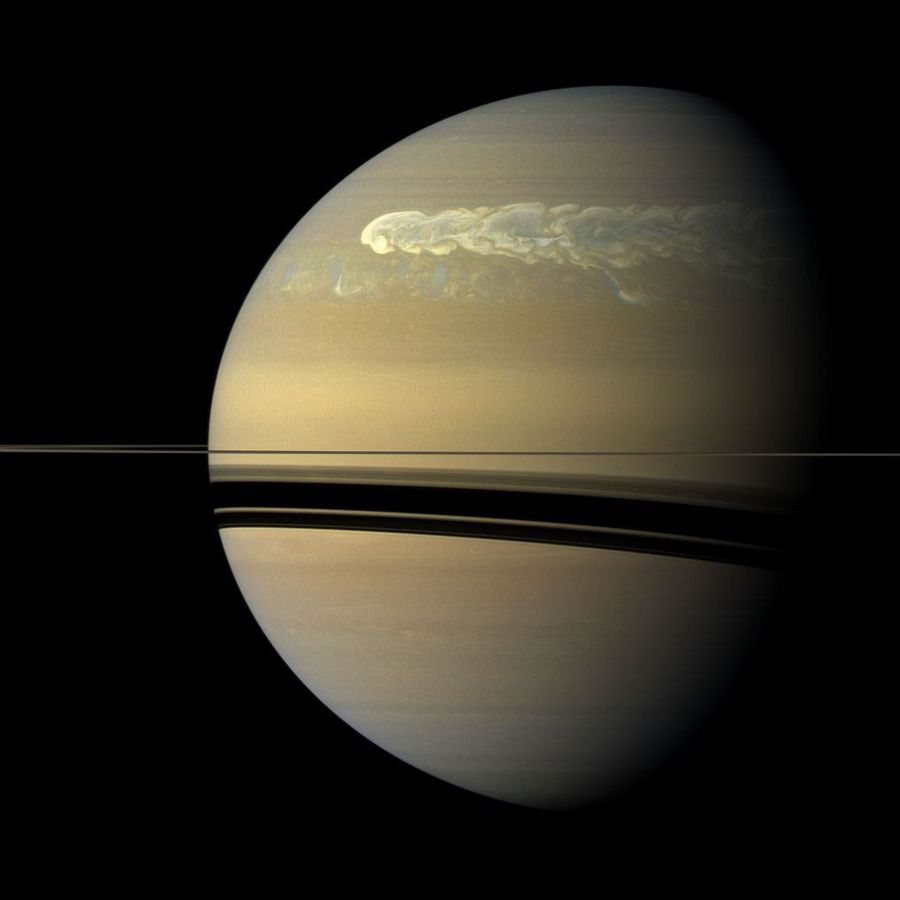
Saturn’s clouds appear as faint bands of yellow, brown and gray. Near the equator, winds in the upper atmosphere reach about 500 m/s (1,800 km/h). The strongest hurricane-force winds on Earth reach about 110 m/s.
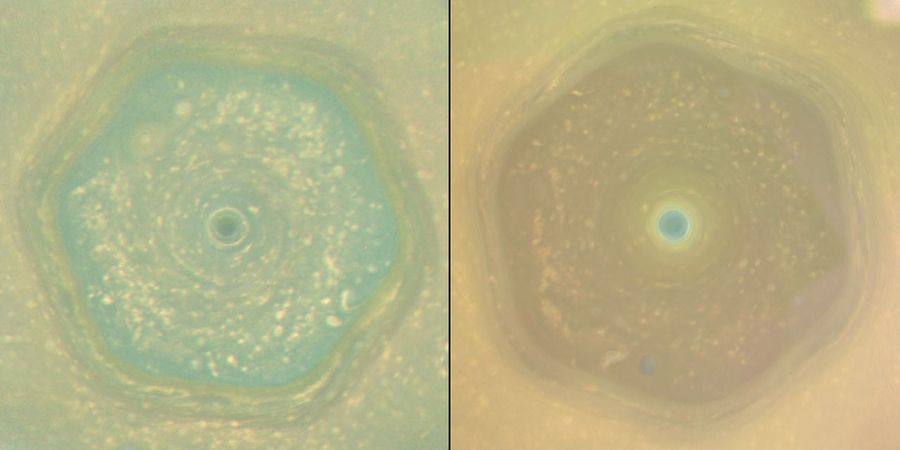
Around the north pole, a six-sided jet stream about 30,000 km across carries winds of about 322 km/h. Voyager first noticed this hexagon in the early 1980s; Cassini observed it more closely.
New in 2026
A ten-sided wave in the south.
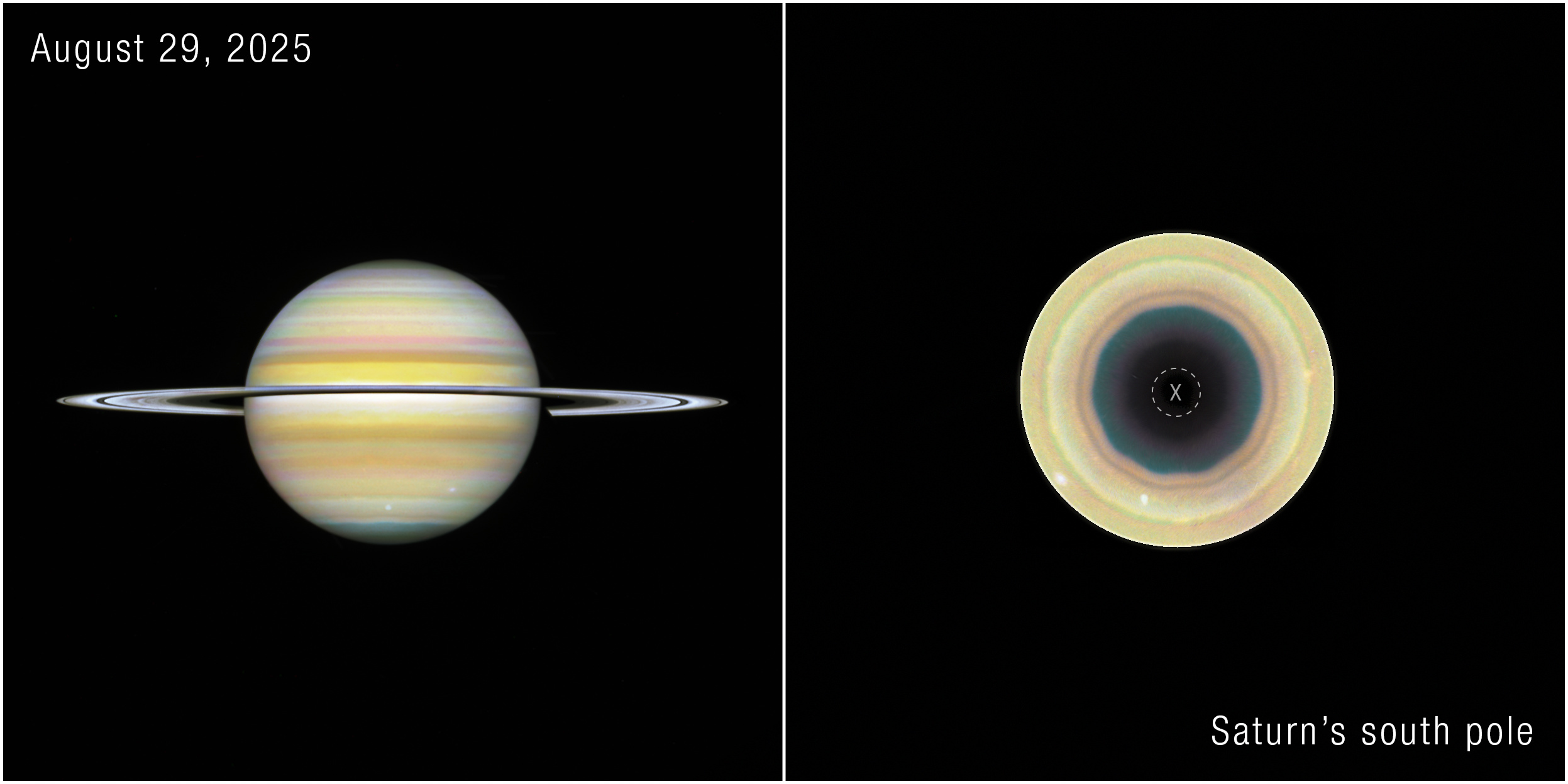
For decades the hexagon had no southern counterpart. A study published in September 2026 reported Hubble observations of a giant, evolving, 10-sided wave encircling the south pole — the first large, regular-sided jet pattern seen in Saturn’s southern hemisphere.
04 / Seasons & day
Seven-year seasons.
A day measured by the rings.
Saturn’s axis is tilted 26.73°, a little more than Earth’s 23.5°, so Saturn has seasons. One orbit takes 29.4 Earth years, so each season lasts about seven Earth years.
Cassini watched the equinox in August 2009, when sunlight fell edge-on across the rings, and reached the northern summer solstice on May 24, 2017.
Sources: NASA Space Science Data Coordinated Archive: Saturn Fact Sheet (opens in a new tab)NASA Science: Saturn facts: Saturn: Facts (opens in a new tab), Cassini rings science: Cassini science: Rings (opens in a new tab), Cassini timeline: Cassini timeline (opens in a new tab)
How long is a day?
10 h 33 min 38 s.
A planet without a surface has no landmark to time. Vibrations inside Saturn make waves in its rings; by modeling those waves, researchers measured the length of the day in 2019. As Cassini project scientist Linda Spilker put it, “The rings held the answer.” The NSSDC fact sheet still lists an earlier value, 10.656 hours.
Sources: NASA JPL: Scientists Finally Know What Time It Is on Saturn (opens in a new tab)NASA Space Science Data Coordinated Archive: Saturn Fact Sheet (opens in a new tab)
Explore the rings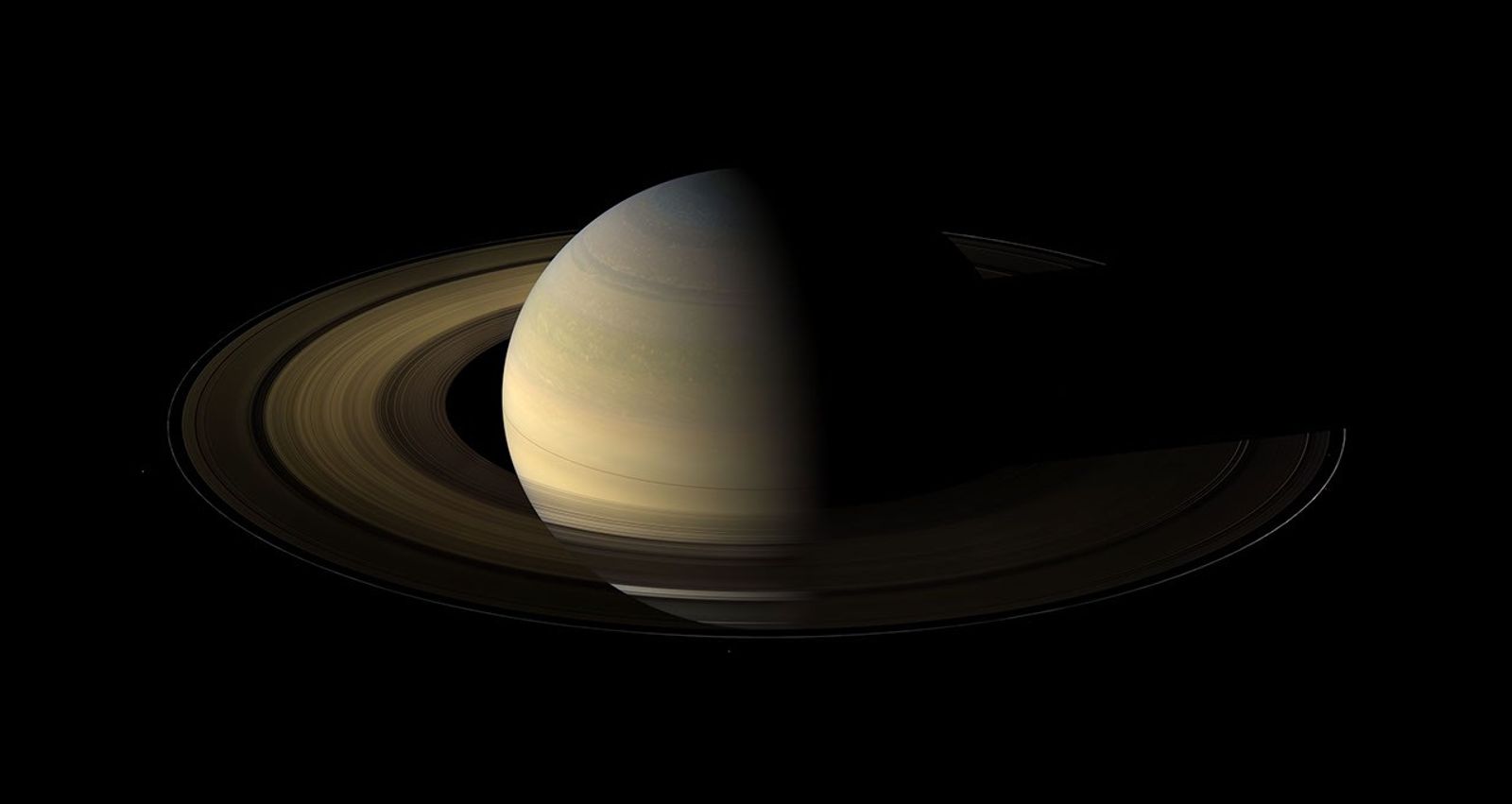
05 / Magnetic field
A field lined up
with its spin.
Saturn’s magnetic field is weaker than Jupiter’s but much stronger than Earth’s. Unusually, its magnetic axis is almost exactly aligned with its spin axis: the NSSDC lists the tilt between them as 0.0°.
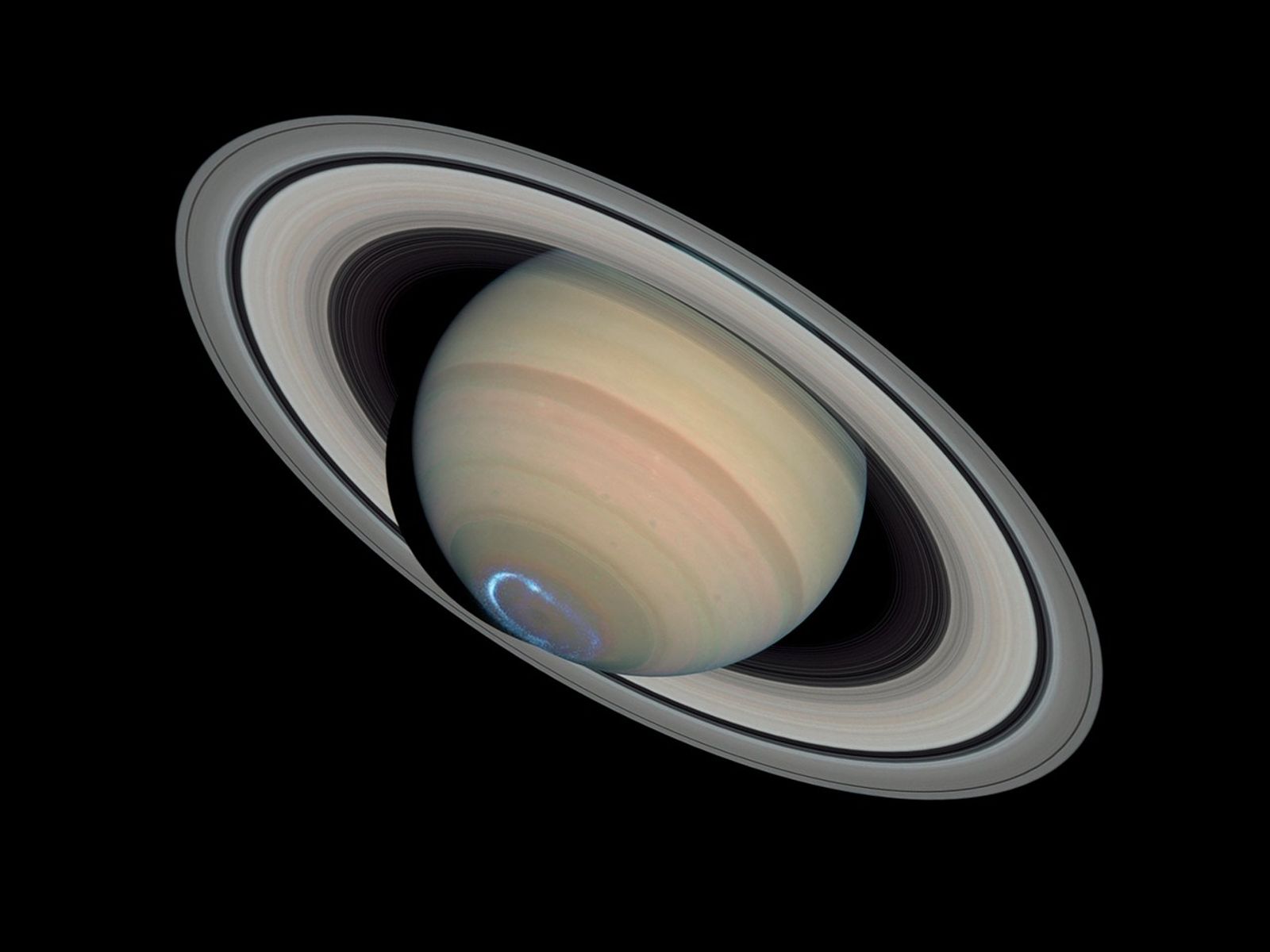
Saturn has aurorae near its poles. Some are driven by particles from its moons and by its rapid rotation rather than by the solar wind, and scientists do not yet fully understand them.
Sources: NASA Science: Saturn: Facts (opens in a new tab)NASA Space Science Data Coordinated Archive: Saturn Fact Sheet (opens in a new tab)
Sources
Where these facts come from
Values were checked against these pages in October 2026. Fact sheets are revised over time; if a value here disagrees with the current source, the source wins.
- Saturn: Facts (opens in a new tab)NASA Science
- Scientists Finally Know What Time It Is on Saturn (opens in a new tab)NASA JPL · January 18, 2019
- Saturn Fact Sheet (opens in a new tab)NASA Space Science Data Coordinated Archive
- Saturn Moons (opens in a new tab)NASA Science
- Cassini timeline (opens in a new tab)NASA Science