The moons
293 moons.
A few worth knowing.
Saturn has more confirmed moons than any other planet — 293 as of August 2026, according to NASA. Most are small and far away. A handful are worlds in their own right, and some live inside the rings.
01 / Worlds to know
Oceans, haze,
and moons inside the rings.
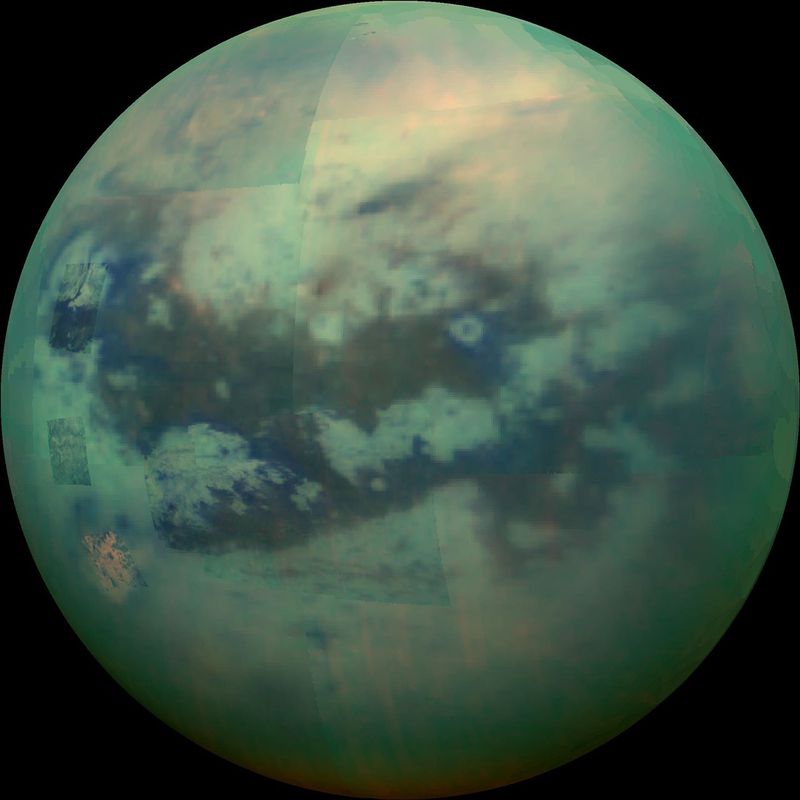
Titan
Bigger than Mercury, wrapped in haze
Titan is larger than the planet Mercury. Its thick atmosphere is mostly nitrogen, and its surface holds seas of liquid methane. In 2005 the Huygens probe made the first landing on a moon of another planet here, and NASA’s Dragonfly is planned to fly between dozens of sites on its surface.
Titan: 2,574.76 km mean radius · 1,221,900 km from Saturn
Sources: NASA Science: Saturn moons: Saturn Moons (opens in a new tab), moon mysteries: 10 Things: Unsolved Mysteries of Saturn’s Moons (opens in a new tab), Saturn exploration: Saturn: Exploration (opens in a new tab)NASA History: 40 Years Ago: Voyager 1 Explores Saturn (opens in a new tab)Johns Hopkins APL: Dragonfly mission confirmed for 2028 launch (opens in a new tab)
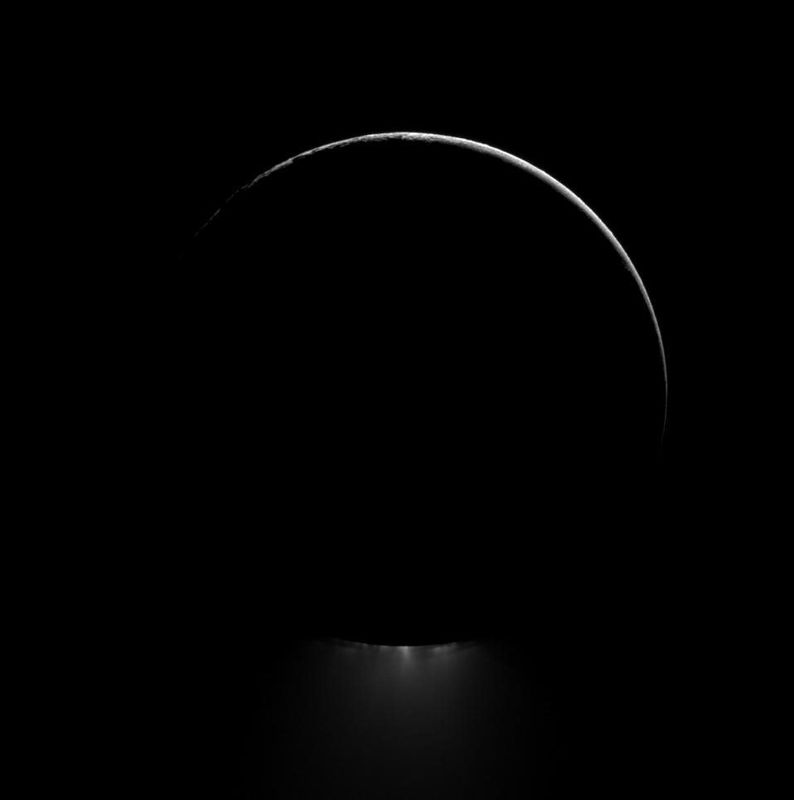
Enceladus
An ocean that feeds a ring
Enceladus is only about 500 km across, yet jets of water vapor and ice burst from warm “tiger stripe” fractures near its south pole. A global ocean under the ice supplies the jets, and the jets supply Saturn’s faint E ring.
Enceladus: 252.10 km mean radius · 238,400 km from Saturn
Find the E ring in the ring table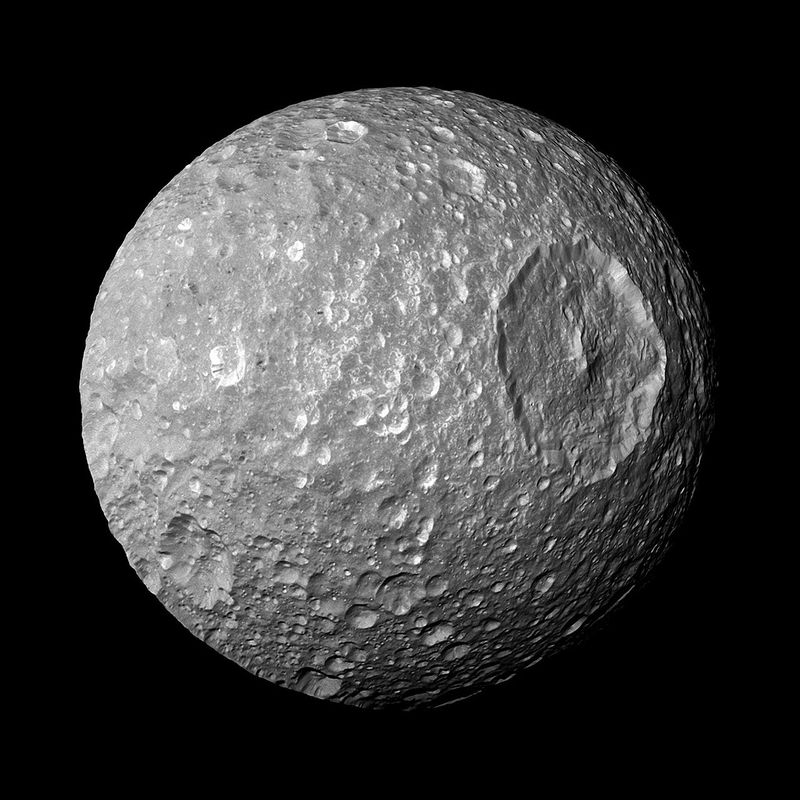
Mimas
A small moon with a long reach
The PDS ring table links the Huygens Gap, at the inner edge of the Cassini Division, to Mimas. Cassini also saw Mimas wobble as it rotates, a clue that it may hide an unusual core or an ocean.
Mimas: 198.20 km mean radius · 186,000 km from Saturn
See the Cassini Division in real dataSources: NASA PDS Ring-Moon Systems Node: Vital Statistics for Saturn’s Rings (opens in a new tab)NASA Science: 10 Things: Unsolved Mysteries of Saturn’s Moons (opens in a new tab)
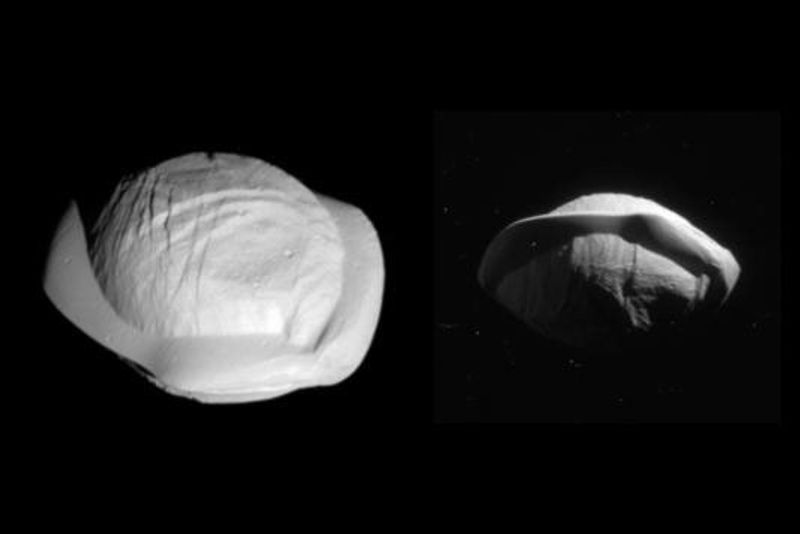
Pan & Daphnis
Moons that live inside the rings
Pan orbits inside the Encke Gap and Daphnis inside the Keeler Gap, and each keeps its gap open. You can measure the width of Pan’s gap yourself in a Cassini radio profile.
Pan: 14.0 km mean radius · 133,600 km from Saturn
Daphnis: 136,500 km from Saturn
Source: NASA PDS Ring-Moon Systems Node: Vital Statistics for Saturn’s Rings (opens in a new tab)
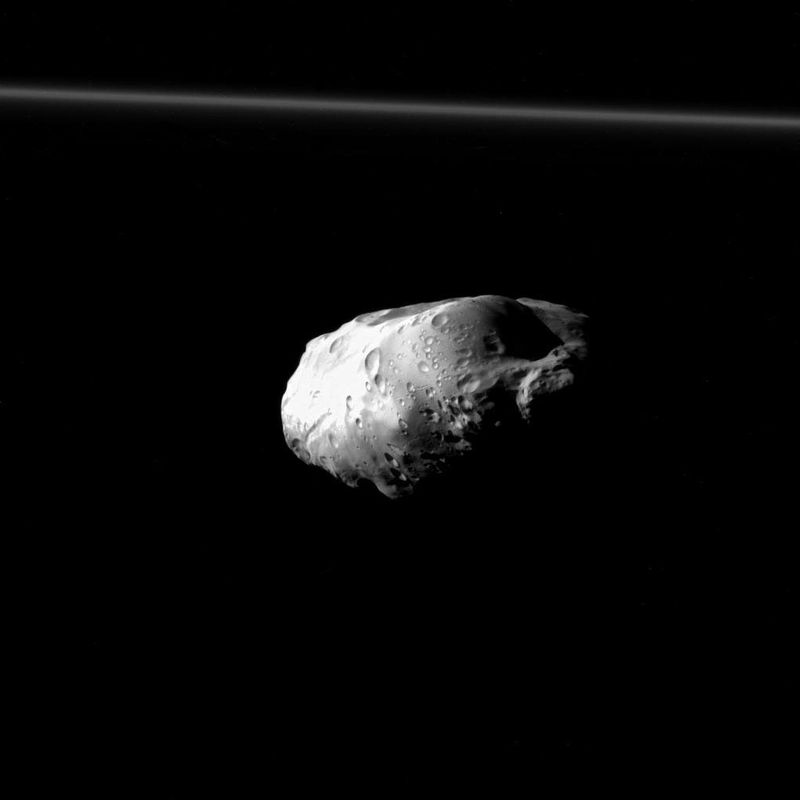
Prometheus & Pandora
Shepherds of the F ring
Voyager 1 tied the braided pattern of the narrow F ring to two newly discovered shepherd moons. Voyager 2 photographed them: Prometheus and Pandora help herd the ring’s particles.
Prometheus: 43.1 km mean radius · 139,400 km from Saturn
Pandora: 40.6 km mean radius · 141,700 km from Saturn
Sources: NASA History: Voyager 1: 40 Years Ago: Voyager 1 Explores Saturn (opens in a new tab), Voyager 2: 40 Years Ago: Voyager 2 Explores Saturn (opens in a new tab)
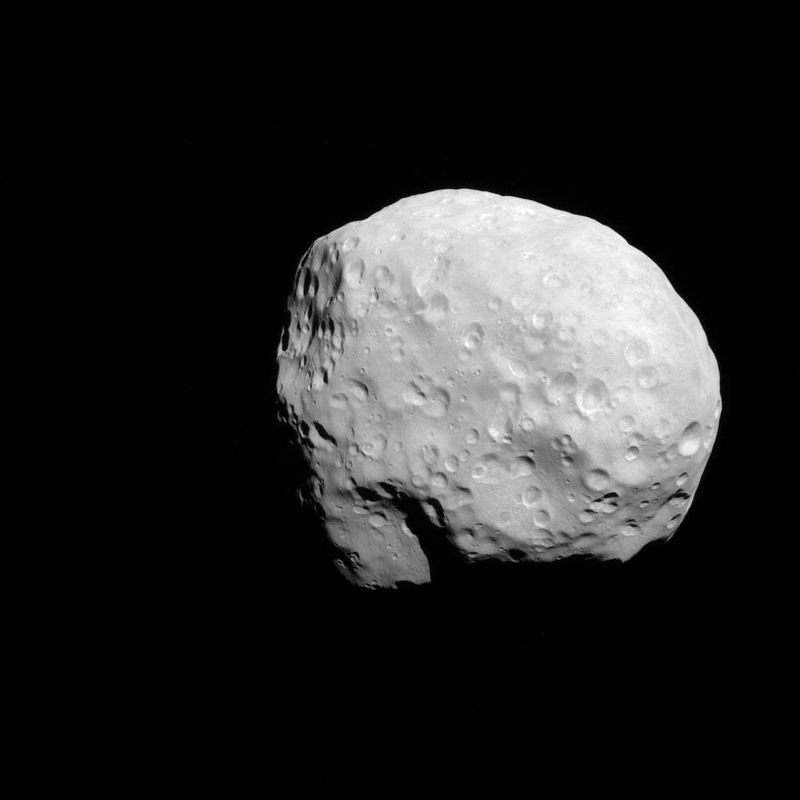
Janus & Epimetheus
Two moons, almost one orbit
JPL lists mean distances of 151,500 km for Janus and 151,400 km for Epimetheus — nearly the same orbit. In 2006 a faint ring was discovered sharing their orbits.
Janus: 89.2 km mean radius · 151,500 km from Saturn
Epimetheus: 58.2 km mean radius · 151,400 km from Saturn
Sources: NASA JPL Solar System Dynamics: Planetary Satellite Mean Elements (opens in a new tab)NASA Science: Saturn: Exploration (opens in a new tab)

Iapetus
Two-toned
Iapetus has been called the yin and yang of Saturn’s moons: its leading hemisphere is as dark as coal (albedo 0.03–0.05), while its trailing hemisphere is much brighter (0.5–0.6).
Iapetus: 734.30 km mean radius · 3,561,700 km from Saturn
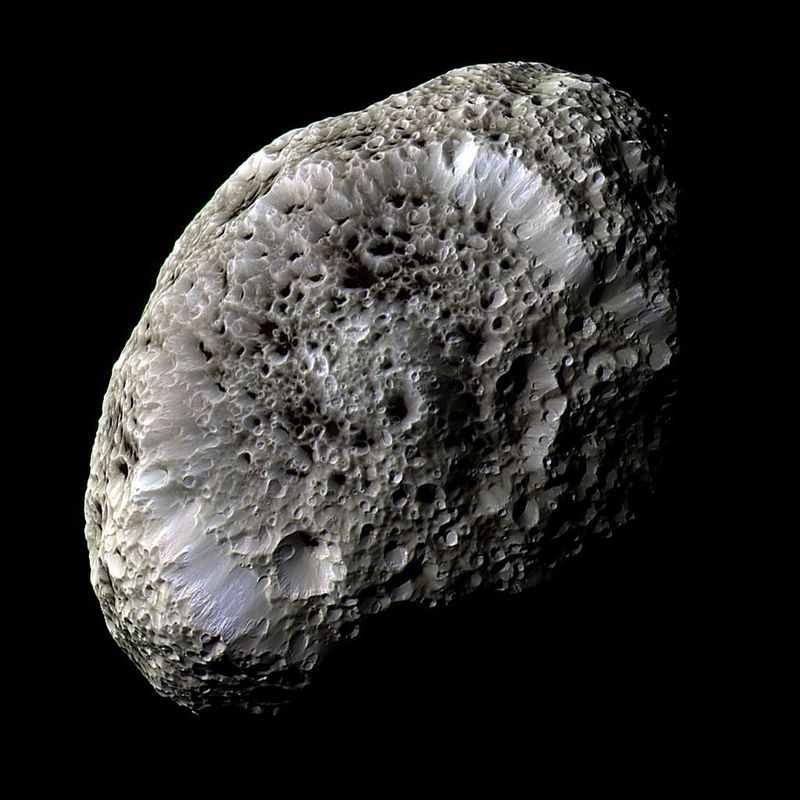
Hyperion
Light, lumpy and tumbling
Hyperion’s mean density is about 0.54 g/cm³ — lower than that of water ice — and the NSSDC records its rotation as chaotic rather than locked to Saturn.
Hyperion: 135.00 km mean radius · 1,481,500 km from Saturn
Sources: NASA JPL Solar System Dynamics: Planetary Satellite Physical Parameters (opens in a new tab)NASA Space Science Data Coordinated Archive: Saturnian Satellite Fact Sheet (opens in a new tab)
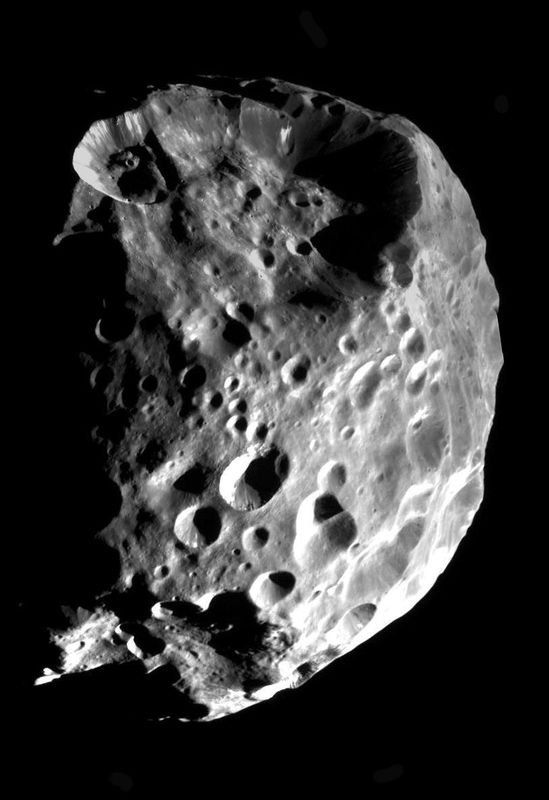
Phoebe
Going the other way
Phoebe orbits about 12.9 million km from Saturn, in the opposite direction to the major moons (its inclination is 175°). It likely formed elsewhere and was captured. In 2009 the Spitzer Space Telescope revealed a huge, faint ring along its orbit.
Phoebe: 106.50 km mean radius · 12,929,400 km from Saturn
Sources: NASA JPL Solar System Dynamics: Planetary Satellite Mean Elements (opens in a new tab)NASA Science: moon mysteries: 10 Things: Unsolved Mysteries of Saturn’s Moons (opens in a new tab), Saturn exploration: Saturn: Exploration (opens in a new tab)
02 / Compare
Sixteen moons,
side by side.
Sort by size, distance, orbital period or density. Values are published by NASA’s Jet Propulsion Laboratory; discovery records come from NASA’s moon list.
| PanRing moon | 14.0 | 133,600 | 0.575051 | 0.3650 | 1990M.R. Showalter |
|---|---|---|---|---|---|
| DaphnisRing moon | —JPL lists no mean radius; the NSSDC gives 4.3 × 4.1 × 3.2 km. | 136,500 | 0.594080 | —not listed | 2005Cassini Imaging Science Team |
| AtlasRing moon | 15.1 | 137,700 | 0.604602 | 0.3850 | 1980Voyager Science Team |
| PrometheusRing moon | 43.1 | 139,400 | 0.615878 | 0.4784 | 1980Voyager Science Team |
| PandoraRing moon | 40.6 | 141,700 | 0.631369 | 0.4948 | 1980Voyager Science Team |
| EpimetheusCo-orbital moon | 58.2 | 151,400 | 0.697012 | 0.6375 | 1977, 1980J. Fountain, S. Larson (1977); D. Cruikshank (1980) |
| JanusCo-orbital moon | 89.2 | 151,500 | 0.697353 | 0.6381 | 1966, 1980A. Dollfus (1966); D. Pascu (1980) |
| MimasMajor moon | 198.20 | 186,000 | 0.942422 | 1.1501 | 1789W. Herschel |
| EnceladusMajor moon | 252.10 | 238,400 | 1.370218 | 1.6097 | 1789W. Herschel |
| TethysMajor moon | 531.10 | 295,000 | 1.887802 | 0.9840 | 1684G.D. Cassini |
| DioneMajor moon | 561.40 | 377,700 | 2.736916 | 1.4781 | 1684G.D. Cassini |
| RheaMajor moon | 763.50 | 527,200 | 4.517503 | 1.2372 | 1672G.D. Cassini |
| TitanMajor moon | 2,574.76 | 1,221,900 | 15.945448 | 1.8814 | 1655C. Huygens |
| HyperionSmall outer moon | 135.00 | 1,481,500 | 21.276658 | 0.5386 | 1848W.C. Bond, G.P. Bond, W. Lassell |
| IapetusMajor moon | 734.30 | 3,561,700 | 79.331002 | 1.0887 | 1671G.D. Cassini |
| PhoebeIrregular moon | 106.50 | 12,929,400 | 550.303910 | 1.6428 | 1898W.H. Pickering |
Distances and periods are JPL mean orbital elements (Laplace plane, epoch 2000-01-01.5 TDB). JPL notes they are not intended for computing positions; use JPL Horizons for that. Daphnis has no mean radius in the JPL table; the NSSDC gives its dimensions as 4.3 × 4.1 × 3.2 km.
Sources: NASA JPL Solar System Dynamics: physical parameters: Planetary Satellite Physical Parameters (opens in a new tab), mean elements: Planetary Satellite Mean Elements (opens in a new tab)NASA Science: Saturn Moons (opens in a new tab)NASA Space Science Data Coordinated Archive: Saturnian Satellite Fact Sheet (opens in a new tab)
03 / Counting moons
Why the number
keeps changing.
Astronomers keep finding small, distant moons and confirming their orbits. An announcement of 128 new moons in March 2025 brought Saturn’s total to 274; by August 2026, NASA’s list had reached 293.
Expect the number to change again. If you cite it, give the date and the source.
Sources: NASA Space Science Data Coordinated Archive: Saturnian Satellite Fact Sheet (opens in a new tab)NASA Science: Saturn Moons (opens in a new tab)
Sources
Where these facts come from
The downloadable table lists every source in its header. Radii and densities follow JPL’s Planetary Satellite Physical Parameters; orbits follow JPL’s Planetary Satellite Mean Elements.
- Saturn Moons (opens in a new tab)NASA Science
- 40 Years Ago: Voyager 1 Explores Saturn (opens in a new tab)NASA History
- 10 Things: Unsolved Mysteries of Saturn’s Moons (opens in a new tab)NASA Science
- Saturn: Exploration (opens in a new tab)NASA Science
- Dragonfly mission confirmed for 2028 launch (opens in a new tab)Johns Hopkins APL · April 17, 2024
- Enceladus (opens in a new tab)NASA Science
- Vital Statistics for Saturn’s Rings (opens in a new tab)NASA PDS Ring-Moon Systems Node
- 40 Years Ago: Voyager 2 Explores Saturn (opens in a new tab)NASA History
- Planetary Satellite Mean Elements (opens in a new tab)NASA JPL Solar System Dynamics
- Iapetus (opens in a new tab)NASA Science
- Planetary Satellite Physical Parameters (opens in a new tab)NASA JPL Solar System Dynamics
- Saturnian Satellite Fact Sheet (opens in a new tab)NASA Space Science Data Coordinated Archive